Mikal Eckstrom: Textual Analysis of American Indian and American Jewish data sets

My name is Mikal Eckstrom, a Ph.D. candidate at University of Nebraska-Lincoln. This fall, I am teaching an undergraduate course, History of the US Present. This course historicizes modern problems, but one that also allows students to use digital recorders and online discussion boards to produce original research. My personal research, “Marginalized Tribes: Shared Experiences of Jews and Native Americans in the Trans-Missouri West, 1850-1935,” explores Jewish encounters with American Indians in the context of white settlement in Colorado, Kansas, Nebraska, and North and South Dakota. The project relies on settler colonial, whiteness, and computational analysis as its primary methodologies.

For this lightning round, I will share some of my initial findings from my American Indian and American Jewish data sets. I am using textual analysis (statistical package R+ and MALLET [Machine Learning for LanguagE ToolkiT]) and topic modeling to discern gendered pressures unique to the Jewish and American Indian experiences during the peak period of American Indian and non-native allotment in the west. Initial findings show how both groups remembered the same time differently. Finally, I will discuss the responsibilities of working with indigenous histories in the digital humanities and why close reading is still crucial to our craft.

Jeff Malcomson: ExploreBig: The Struggle to Develop a Mobile App for Montana History

I am pleased to have the opportunity to present in the 2016 Six-Shooters session. I am a public historian with nearly 20 years of experience as an archivist in the West. Since 2005 I’ve worked at the Montana Historical Society (MHS) Research Center where I currently serve as the Senior Photograph Archivist. I created the Society’s first blog several years ago (Montana History Revealed, which is still going strong) and have served on the very active MHS Social Media Committee. Throughout my career I’ve actively sought ways to explore and test new tools in the digital humanities. In recent years I’ve become a fairly active editor of Wikipedia articles in Montana and Western history topics, organizing edit-a-thons and trying to improve this popular platform’s presentation of history.

For my Six-Shooters presentation I’ll talk about our experience at MHS over the past two years trying to develop a mobile app for Montana history. The end result, ExploreBig, is finally coming into its own as a tool for sharing the stories of Montana’s most historic places and buildings. We ended up using the Omeka-based Curatescape to build our website and mobile app, but the path to this product was fairly unique. I hope this harrowing story of high elective office, high-tech education, lowly bureaucratic squabbling, and low budget difficulties may serve to help others avoid similar problems in the future.

Lindsey Passenger Wieck: El Tecolote, A Bilingual Neighborhood Newspaper and Community Building

Hello! I’m Lindsey Passenger Wieck, and this year I’m a postdoctoral fellow at the University of Notre Dame (where I finished my Ph.D. earlier this year). This fall, I’m teaching an undergraduate course on the History of San Francisco that emphasizes digital writing and using DH tools. In 2017, I’m excited to work on some projects with our library’s Center for Digital Scholarship to help spread access to the digital humanities at our university. My manuscript, The Mission Impossible: The Cultural Politics of Community and Gentrification in Postwar San Francisco, explores Latino community formation in the Mission District of San Francisco and examines how this creates a space for gentrification. More broadly, I’m interested in the urban and spatial history, especially in the U.S. West.

At the Six-Shooters session, I’ll be talking a bit more about one of the digital components of my manuscript project. Using issues of El Tecolote, a bilingual community newspaper from the San Francisco  Mission District, I show how this newspaper served as tool for community building – for mobilizing residents in the neighborhood, for connecting them to resources and events, for promoting activism, and for warning the Mission’s inhabitants of unsafe spaces. During this panel, I’ll discuss how I conceptualized this mapping project and what I view as the next steps for it to delve deeper into this rich source base.

Chris Wells: Minnesota Environments

I am an associate professor of environmental history at Macalester College, where I direct the school’s Andrew Mellon Foundation-sponsored Digital Liberal Arts initiative. My research focuses on the ways that technology–and especially technological systems–have reshaped the American environment, mediating and structuring people’s relationships with the natural world.

For this lightning round, I will discuss Minnesota Environments, a smartphone app and accompanying website developed in collaboration with George Vrtis (Carleton College). Based on the Omeka CMS and its Curatescape plugin, the resulting project allowed students to research and publish material on Minnesota’s environmental history that users can explore from a smartphone, tablet, or computer.

Sarah Clayton: Making Modern America: Discovering the Great Depression and New Deal

Hello! I’m a Digital Scholarship Specialist at the University of Oklahoma Libraries, where I support faculty and students interested in working on any component of digital scholarship from finding resources, to using and selecting tools for analysis, and finally to sharing their work. I’m very excited to be participating in the Six Shooters Session.

During the session, I’ll be presenting on the Making of Modern America: Discovering the Great Depression and New Deal. This project was the vision of Dr. David Wrobel and Dr. Keith Gaddie and realized through a close collaboration with OU Libraries. The goal was for students to not only learn about the 1930s but also become creators of new knowledge through undertaking original research projects centered around their local communities and sharing their findings in online exhibits complete with archival and modern photographs, documents, videos, interactive maps, and text. To accomplish this, I, along with other librarians, facilitated weekly workshops instructing the students on how to perform archival and field research, conduct oral histories, create interactive maps, and use Omeka to create online exhibits. Currently, we have eleven exhibits available online: five focused on New Deal funded construction projects in central Oklahoma and six recreating driving tours from Oklahoma: A Guide to the Sooner State originally published in 1941. While the students’ final projects were impressive, I was especially struck by how the digital projects enriched their educational experiences and engagement with the course material and our wonderful special collections. We are hoping to repeat a version of this course and expand the website in the future.

A View into the 2015 Six-Shooters Digital History Session

The lineup for the 2015 Six-Shooters digital history lightning round session, sponsored by the WHA Technology Committee, featured six presenters sharing their research, teaching, and public projects (photos by Doug Seefeldt, session chair):

Virtual Buffalo Bill’s Wild West

My colleague James Connolly and I, working with staff from the Buffalo Bill Center of the West, and artists and designers from Ball State’s Institute for Digital Intermedia Arts (IDIA), have crafted a computer-generated world that authentically simulates the Wild West show dramatizing frontier life. Virtual Buffalo Bill’s Wild West is a multiplayer virtual world that simulates Buffalo Bill Wild West Show circa 1899. The project serves as a prototype for developing and testing various designs and configurations that integrate a 3D environment and a web-based digital archive. This digital history project is built in Unity 3D using custom software created by IDIA Lab. The archive employs the Collective Access content management system, using VRA Core standards.

This collection contains source materials for the three-dimensional recreation of Buffalo Bill’s Wild West and Congress of Rough Riders of the World, a traveling exhibition that toured North America and Europe between 1883 and 1908. This enormously popular show presented to its audiences a recreation of life in the Old West, complete with spectacular displays of riding and shooting, as well as performances by “rough riders” from around the world. In addition to materials used as the basis for the design of the virtual world, this archive contains primary sources that provide historical context for understanding the Wild West show, its role in creating popular images of the Old West, the social history of the era.

Cameron Blevins, The Postal West

I am a digital historian studying the nineteenth-century United States and the American West. My current position is Andrew W. Mellon post-doctoral fellow at Rutgers University’s history department and the Rutgers Center for Historical Analysis. Before this, I received my Ph.D. from Stanford University, where I worked at the Spatial History Project and Center for Spatial and Textual Analysis (CESTA).Some of my broader interests include geography, communications, gender history, and information visualization.

At the six shooters session I’ll be giving an overview of my research project, “The Postal West,” which tells a spatial history of the role of the U.S. Post in the integration of the American West. Digital analysis has bee a key part of this project, including building an interactive map with Jason Heppler, Jocelyn Hickox, and Tara Balakrishnan that visualizes the opening and closing of more than 14,000 post offices across the western United States. Rather than focus on the digital methods themselves, however, I’d like to try and convey the big interpretive results and arguments that I’ve made using these kinds of tools.

Visualizing Urban Change in Silicon Valley

Greetings all! I am Jason Heppler, a Ph.D. candidate at the University of Nebraska-Lincoln and the Academic Technology Specialist for the Department of History at Stanford University, where I mostly work on evidence visualization projects and teach digital history. My dissertation, “Machines in the Valley: Growth, Conflict, and Environmental Politics in Silicon Valley” examines contested ideas about space and place as the cities of Silicon Valley grew during the postwar era. These debates gave expression to what I see as environmentalism growing out of specific local concerns, as well as a burgeoning discussion about sustainable cities.

For the Six Shooters, I wanted to talk about some of the data visualization projects I’ve been working on for the digital components of my dissertation. I’m curious to hear your feedback — what works, what doesn’t, what’s missing. In particular, I was interested in trying to examine the spaces of the cities ignored or overlooked by city planners and the reasons behind their absence. I have anecdotal evidence suggesting the uneven (and unequal) patterns of municipal expansion, but by visualizing this unevenness I suggest we can better see the spaces of the city that were given the most attention and the reasons behind their focus.

Creating Citizen Archivists

Slide1

Fortepan Iowa and the Making of Kronofoto


Fortepan Iowa is a research-based, student-centered project conducted at the University of Northern Iowa between three different departments, in two different colleges, across four different disciplines. Bettina Fabos in visual communications and Sergey Golitsynskiy in computer science, from the Communication Studies Department, Noah Doely in photography from the Art Department, and myself in public history, from the Department of History are working to create an interactive digital platform for collecting, archiving, displaying, and utilizing amateur photographs of Iowa’s past.

Slide2

The project embodies our individual specialties in creating digital platforms, collecting and documenting historical images, and displaying and interpreting those images, and it represents our collective commitment to open-source platforms and to student training. It also showcases the history of Iowa because the images it contains are of events and places throughout the state taken between 1860 and 2000, the era of print photos.

The name of the project itself, “Fortepan,” comes from the widely popular film paper made by the Hungarian company Forte and stands in for the idea of amateur photography. Fortepan Iowa is the sister site to the original Fortepan project.

Slide3

The Fortepan Concept

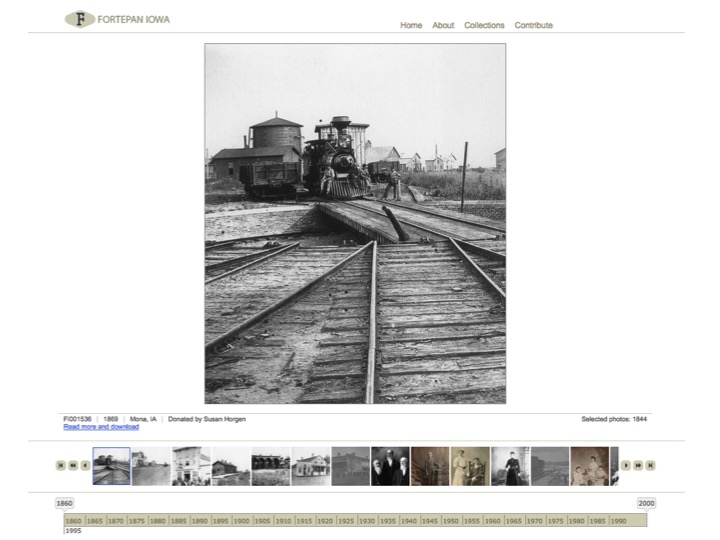
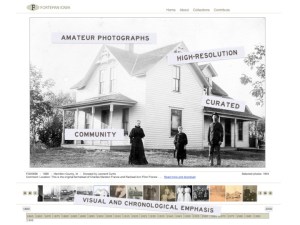
The project is designed to showcase the snapshot, the ubiquitous window into the life of the ordinary citizen. The images featured on the project’s homepage have been curated for their aesthetic and documentary value. These images are arranged photograph by photograph chronologically along an interactive timeline, which users can use to browse through the collection year by year. All the images are scanned at a high resolution and available for download and use under the Creative Commons Attribution-Share Alike 4.0 International Public license. These ideas collectively comprise what we call the Fortepan Concept.

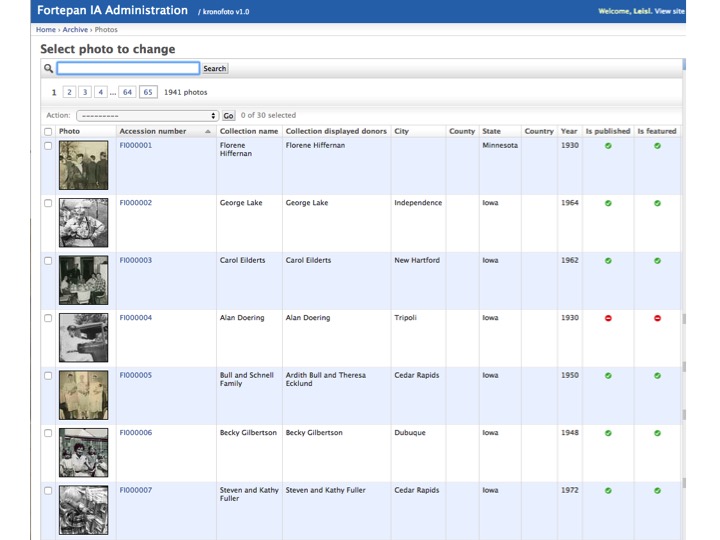
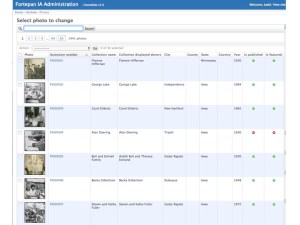
Our students have largely been responsible for the core of the collections by documenting and digitizing these photographs from their own families and communities. In doing so, they have not only built a digital archive from the ground up, they have learned much about digital platforms and culture, archival and collections work, and working collaboratively.

Slide4

Kronofoto

The platform itself, called Kronofoto, is an original work unique to the project. The project collaborators have engineered it from the ground up to privilege the visual image, similar to the original Fortepan, but to also interpret the collections in a variety of ways. Currently, users can browse the images chronologically along the timeline, through individual collection, and by donor. But we designed Kronofoto to be highly malleable.

We are currently working on a spatial interpretation of the collections through an interactive map of the state and tagging individual images so that users can browse them by subject. We will also be adding excerpts from oral history interviews to some images to allow users to listen to the stories that accompany these photographs. Lastly, we are continuing to add to the collections by integrating all the donated images, including those not featured on the homepage. We intend to allow users to contribute their own images and stories, thereby making the project’s platform a bridge between professional archiving and citizen participation such that it becomes a pathway to create citizen archivists and empowers communities to document their own history for themselves.


Slide5

The project has been funded by Humanities Iowa and through a university Capacity-Building grant and it launched in March 2015. To date, the Fortepan Iowa project has involved more than 165 students, worked with 200 donors, and collected and digitized almost 5500 images, nearly 2000 of which are currently featured on the public website. We are continuing to grow the archive, to improve the digital interface, and to use it to train and educate new cohorts of students. We will also be applying for grants from the National Endowment for the Humanities to continue to fund the project’s infrastructure and to prepare the Fortepan Concept and Kronofoto for public release.